Key Takeaways
- Manual collections processes, poor visit compliance, and mismatched case allocation are the core reasons field collections underperform.
- Location intelligence addresses these gaps through auto case allocation, route optimization, delinquency mapping, true visit validation, and demographic enrichment
- A location-intensive, AI/ML-powered approach can improve collections performance by up to 10%.
80% of an organization’s data has a location component. Yet for most NBFCs and MFIs, that data is meaningless without insights.
Cases get allocated without geographic context, travel routes go unoptimized, and managers have no real-time visibility into what is happening on the ground. Eventually, collections performance suffers, and so do recovery rates.
Location intelligence closes these gaps by helping lenders get the right agent to the right borrower, on time. This blog takes a closer look at how NBFCs and MFIs can put it to work in field collections.
What is Location Intelligence?
Location intelligence is the process of analyzing geospatial data to derive actionable insights. In field collections, it helps make decisions about who visits whom, when, and by which route based on data points like,
- Address coordinates
- Agent location
- Route distance
- Geographic risk patterns
Also Read: The Difference Between Location Intelligence and Business Intelligence
Common Challenges in Field Collections
For NBFCs and MFIs, field collection is not a straightforward operation. Borrowers are spread across remote and semi-urban geographies, addresses are inconsistent, connectivity is unreliable, and most teams are still managing this complexity without the right tools and systems in place. All of this translates directly into the challenges collection teams face on the ground:
Inconsistent follow-ups: Follow-up schedules rely on individual discretion, leading to delays and missed touchpoints with borrowers.
Poor visibility: Managers lack real-time insight into agent movements, visit outcomes, and borrower interactions.
Low visit compliance: In remote areas with limited connectivity, confirming whether a collection agent actually reached the borrower remains a persistent challenge.
Heavy manual workloads: Teams remain dependent on pen and paper or spreadsheets for case tracking and planning.
Limited portfolio coverage: Without a structured system, lower-DPD buckets that require early field visit get deprioritized.
Loss of visibility with outsourced collections: Outsourcing to third-party agencies often means losing direct oversight of how cases are handled, making performance monitoring and compliance harder to enforce.
These inefficiencies not only impact collection agents’ productivity but also reduce overall recovery rates.
Leveraging Location Intelligence to Increase Collection Rates and Area Coverage
A McKinsey report suggests that adopting a location-intensive, AI/ML-powered approach can improve collections performance in NBFCs and MFIs by up to 10%.
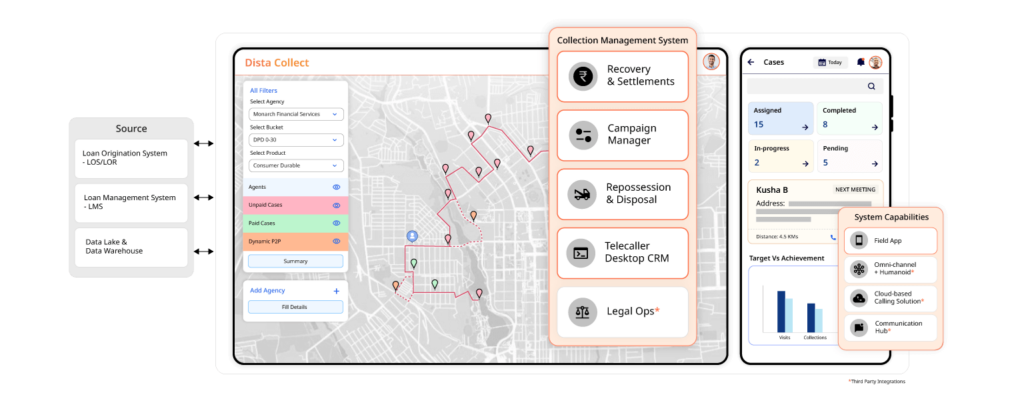
Dista Collect is a unified debt collections CRM with location at its core. Purpose-built for NBFC and MFI, it sits above a typical collections stack as a single source of truth and control for,
- Smarter territory planning and case allocation based on location, skillset, and capacity
- Route optimization to reduce travel time and increase cases covered per day
- Real-time tracking of collection agent activity and visit outcomes
- Configurable strategy and campaign management without manual intervention
With location intelligence NBFC leaders can move from simply reacting to overdue accounts to becoming proactive by employing strategically planned collection activities and executing them.
This proactive approach leads to better collections and lower operational costs.
Also Read: India’s Top NBFC Streamlines End-to-End Debt Collections With Dista Collect
Key Applications of Location Intelligence for Field Collections in NBFCs and MFIs
1. Address Geocoding
Borrower addresses across Tier-2 and Tier-3 cities are often incomplete, inconsistent, or incorrectly captured at the time of loan origination. Address geocoding converts these addresses into precise geographic coordinates, making it possible to accurately locate and route to borrowers before a visit is ever assigned.

This helps collection teams:
- Eliminate invalid and incorrect borrower data from the portfolio
- Verify addresses before cases are dispatched to agents
- Improve overall data accuracy, reducing wasted field visits to unreachable locations
2. Auto Allocation of Cases to Collection Agents
Location intelligence ensures that cases are allocated to the right branches, so agents operate within defined areas and cover borrowers in proximity to each other in a structured manner.
Dista Collect goes a step further by factoring in additional parameters at the assignment level with the SPACE framework.

This way, agents spend more time on cases where they are most likely to succeed, while also taking the most optimal route to cover them.
Also Read: Leading MFI Gets Real-time Visibility Into Field Agents With Dista
3. Route Optimization for Center Visits
Collection agents need to make center visits to action their cases. With regular business expansion, the number of centers keeps increasing, and NBFC firms often miss re-optimizing agent routes as new centers come online and branch mappings change.
This results in agents taking longer routes, spending more time traveling, and less time at the center.
Dista’s AI-ML engine calculates the shortest and fastest routes by considering multiple variables and constraints, such as FCE location, the manager they are mapped to, and more.
https://www.youtube.com/watch?v=5jeAQJCory0&t=1s
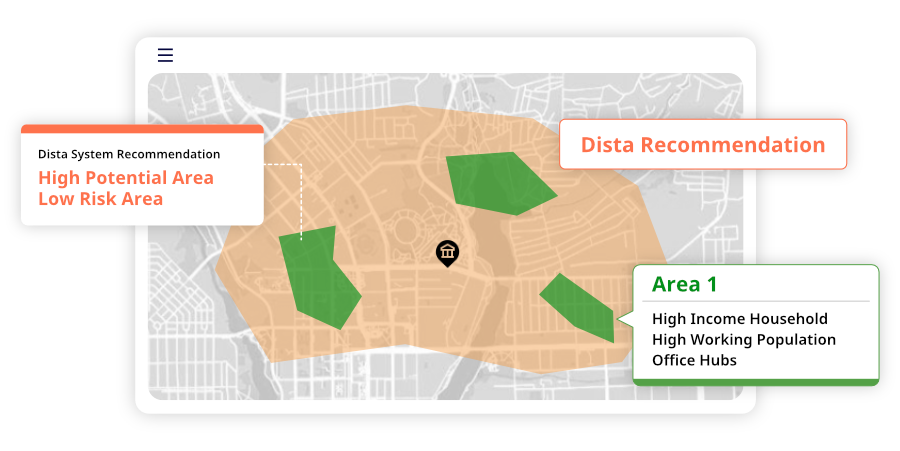
4. Delinquency Mapping by Geography
Delinquency refers to the failure of a borrower to make a loan repayment by its due date. In collections, accounts are typically bucketed by how many days past due they are — and where those accounts are located matters as much as when they became overdue.
Location intelligence helps collections teams map delinquency patterns against geography, credit scores, and customer profile data so that recovery teams can:
- Identify high-risk geographic pockets and direct field effort where it will have the greatest impact
- Move away from distributing agent bandwidth evenly across a territory regardless of actual risk concentration
- Turn field collections from a reactive, case-by-case exercise into a planned, risk-prioritized one
5. True Visit Validation
Low visit compliance is one of the hardest problems to solve in remote field collections. Location intelligence addresses this by validating visits against GPS and geocoded address data, distinguishing a genuine on-ground visit from a logged one. This is tracked through two metrics:
- True visit coverage: the volume of borrowers actually and verifiably reached
- True visit intensity: whether the correct, high-priority borrowers were the ones being met
Learn More: How Can MFIs Boost Visit Compliance With Field Force Management
Benefits of Location Intelligence in Field Collections
NBFCs leveraging a location intelligence-powered field force management systems have reported up to a 10% improvement in collection rates through,
- Targeted and streamlined workflows with real-time access to borrower locations and account details
- Optimized routes and reduced travel times, allowing collection agents to focus on core collection activity
- Stronger management visibility into field operations, including visit outcomes and agent movement
Best Practices for Enhancing Field Collections Throughput
Pairing digital channels — bot calls, SMS reminders, and telecalling — with location-led physical visits lets institutions attempt low-cost digital recovery first and route only the accounts that genuinely need a human visit to the field.
This phygital approach keeps collection agent bandwidth focused on cases where in-person contact actually moves the needle.
Also Read: Why Phygital — A Mix of Digital and Field Debt Collections – Works for NBFCs
FAQs
What is the role of a field collection agent?
A field collection agent visits borrowers in person to recover overdue loan payments. Their work includes conducting center meetings, following up on delinquent accounts, capturing visit dispositions, and coordinating with telecalling teams on escalated cases.
What is true visit coverage in field collections?
True visit coverage measures how many borrowers a collection agent has actually and verifiably visited, as distinct from visits that are only logged. It is validated using GPS and geocoded location data, and tracked alongside true visit intensity, which checks whether the right, high-priority borrowers were the ones being reached.
Can digital and field collections work together?
Yes. Most NBFCs attempt recovery through digital channels such as bot calls, SMS, and telecalling first, and route only the non-responsive accounts to a field visit. This phygital approach keeps collection agent bandwidth focused on cases where in-person contact is genuinely needed.
How does Dista Collect help with route planning and visit scheduling?
Dista Collect’s AI-ML engine calculates the most efficient routes for collection agents based on their current location, the number of cases to be covered, center locations, and branch geography. Visit schedules are optimized in real time, reducing travel time and increasing the number of productive visits an agent can complete in a day.
How does Dista Collect integrate with existing collections systems?
Dista Collect sits above the LMS and other collections systems as a unified layer. This gives collection teams a single view of every case without replacing existing systems, and allows for automated triggers, real-time data sync, and configurable workflows across the collections lifecycle.
Implementing Location-First Strategies for Faster & Efficient Recoveries
Location intelligence and digital tools are no longer just technological advancements; they are strategic imperatives. By using these solutions well, NBFCs can strengthen their field operations, improve efficiency, increase recovery rates, and build a more resilient debt collection process. The future of successful debt recovery for NBFCs lies in combining location data with the right mix of digital and field-based collection strategies.
Interested in exploring how Dista Collect can help fine-tune your field collection efforts? Get in touch with our team now.