Demand for recovery agents across Indian banks and NBFCs rose by 46% in the second half of 2024. This was the sharpest six-month increase in recent years. It could be attributed to rising delinquencies according to TeamLease data cited in Business Standard. At the same time, the RBI’s Financial Stability Report flagged stressed assets in the NBFC microfinance segment rising from 3.9% to 5.9% in March 2025.
These are not isolated data points. They describe a single operational reality: for a significant share of India’s lending book, the field collector remains the primary collection mechanism.
Understanding the why requires looking past debt collection strategy.
The Real Ceiling on Digital Collections
Digital collections infrastructure earns its place at the early stage. At 0-30 DPD: automated outreach, IVR, SMS, WhatsApp, is the right first layer, and no institution is running manual outreach at that threshold.
The ceiling appears at 30-90 DPD, particularly in Tier-2 markets and beyond. Telecaller PTPs at that stage rarely convert without a field visit to back them. The borrower relationship that determines whether someone honors a commitment or avoids a call was not built by an IVR message. It was built by a person who showed up.
What a Field Visit Is Actually Doing
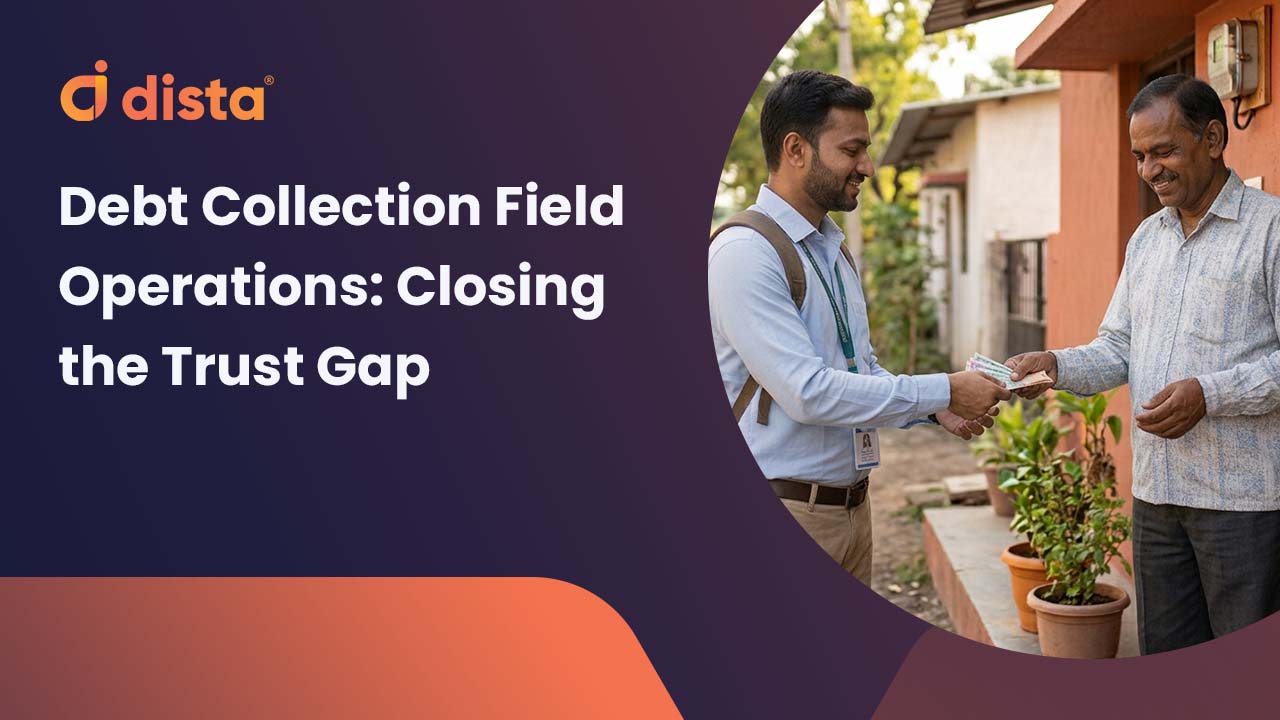
A field visit is not only a collection action. It is the moment the institution shows up physically in a borrower’s life, and that presence carries weight that no digital channel replicates.
- The agent who handles the first loan conversation is building the foundation the collections team will draw on 18 months later.
- Borrowers who trust the person who sold them the loan communicate hardship earlier and honor face-to-face commitments at higher rates.
- Trust built at origination reduces collections friction later, measurable in PTP conversion rates, early hardship disclosure, and renewal behavior.
This is not a behavioral insight. It is an operational variable.
Where Field Collections Break Down
Most institutions cannot execute field visits consistently enough for trust to accumulate. A field visit is a sequence of decisions:
- Who gets visited
- In what order
- By whom
- With what prior context
When that sequence is poorly managed, the visit becomes a friction event rather than a trust event.
The failure modes are consistent across the sector –
- An agent visits a borrower who settled yesterday because the LMS has not synced.
- A new agent inherits a beat with no relationship history because the previous agent’s contextual knowledge was never captured.
- A supervisor manages on day-old data and misses the DPD 1-7 window, the period where ICRA’s MFI stress analyses identify the highest recovery probability.
Sa-Dhan’s Bharat Microfinance Report 2025 puts the scale of the problem plainly:
- PAR 30+ rose from 2.1% to 6.2% in a single year.
- Frontline staff attrition in NBFC collections teams exceeds 75% annually, per TeamLease.
Every departing agent takes unrecorded borrower context with them.
What Location Intelligence Makes Possible
Location intelligence addresses the gap between field visits happening and field visits making a difference.
- Geo-verified check-ins confirm visits at the right address at the right time, closing the LMS sync gap.
- Beat optimization built on location-first clustering ensures agents cover the right borrowers in the right sequence.
- Customer 360 arms every agent with prior context, what was discussed, what was committed, what the borrower’s situation was the last time someone visited.
The result is relationship continuity at scale: the ability to make every field visit feel like a continuation rather than a cold start.
Field Ops as a Trust Instrument
Demand for hiring recovery agents went up to 46% in six months.
- PAR (Portfolio at Risk) 30+ nearly tripling in a single year.
- Frontline attrition above 75%.
These numbers cross institution types and point to the same gap, collections infrastructure that cannot sustain the field relationships it depends on.
Institutions investing in location intelligence are not tracking agents for tracking’s sake. They are building the operational foundation that makes every field visit, from origination through 90 DPD, count toward something. That is what the borrower is responding to when they open the door.
See how Dista Collect brings location intelligence to field collections, request a demo.