
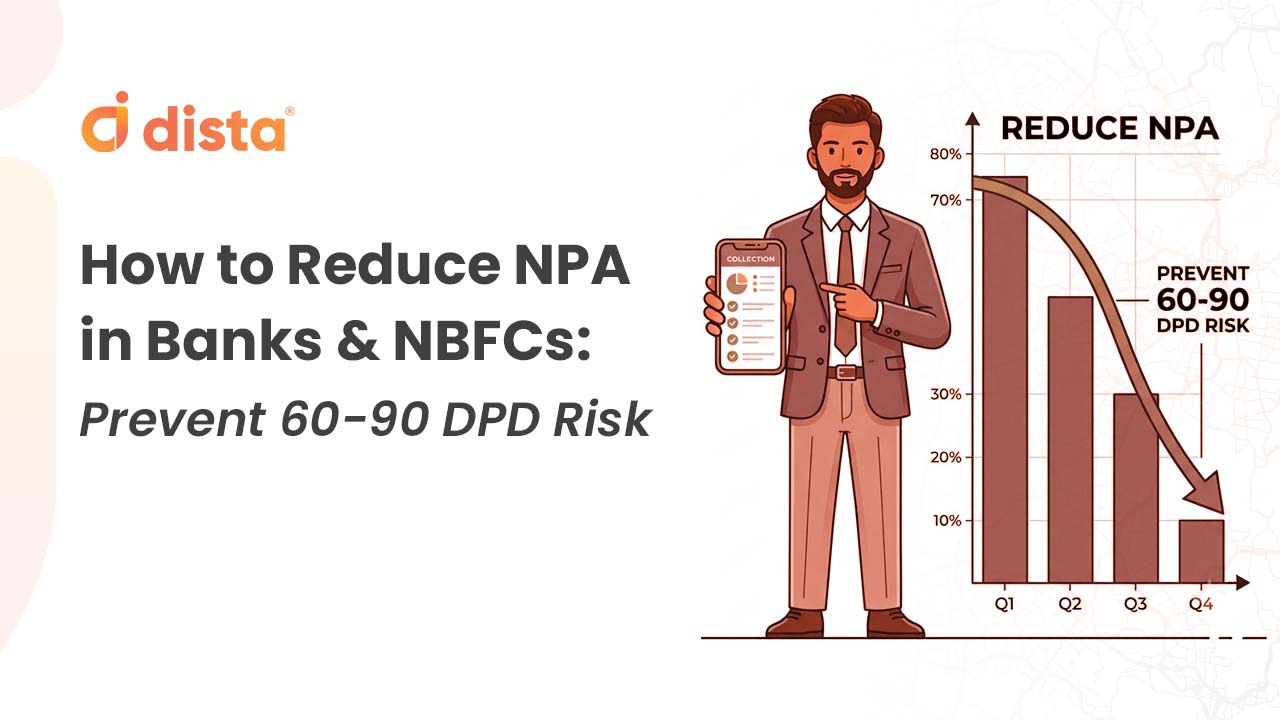
Preventive Measures for NPA: What Banks, NBFCs and MFIs Should Prioritize
Preventing NPA formation requires action well before an account crosses into default. Lenders that invest in accurate credit appraisal, watch repayment behavior closely after disbursement, and engage borrowers consistently tend to catch stress early enough to act on it. The accounts that slip are usually the ones where warning signs were visible but no structured response followed. Timely outreach to SMA accounts, matched with the right resolution option, is where the difference is made.
Where NPA Prevention Breaks Down
Most NPA formation follows the same chain of failure. It starts with weak credit assessment at origination: income overstated, repayment capacity misjudged, or collateral overvalued. This puts accounts at risk before the first EMI is due. When borrowers then face cash-flow stress from income disruption, medical shocks, or seasonal income gaps, early warning signals go unnoticed because lenders lack the systems to flag DPD creep in real time.
NPA classification at 90 days is not where the problem starts, it is where the opportunity ends.
By the time an account crosses into SMA-2, the NPA classification is largely confirmed. The real decision window is DPD 60 to 90, a 30-day stretch where field intervention can still change the trajectory.
Static case lists and territory-based beat plans are not built for that kind of precision. At this stage, field force orchestration needs an NPA reduction strategy built around three principles:
- Spatially mapped
- Collector-matched
- Strategy-backed
Here’s a step-by-step approach to preventing NPA risk in the 60-90 DPD bucket.
Step 1: Visualize Where DPD 60-90 Accounts Are Concentrating
Before deciding how to reduce NPAs in banks and NBFCs, you need to see the problem spatially.
Standard LMS show bucket-level counts. They tell you how many accounts are in the 60-90 bucket, segmented by product type or branch. What they do not show is where those accounts are, and more specifically, whether they are dispersed evenly across your geography or clustering in specific micro-zones.
In short, you are seeing the ‘what’ but not the ‘where’.
Why does this distinction matter?
- A dispersed portfolio and a concentrated one require entirely different field responses and preventive measures for NPA reduction.
- Dispersed stress calls for broad coverage, while concentrated stress calls for a more precise intervention.
- The answer often involves more collectors, faster escalation, and a strategy calibrated to the specific conditions of that zone.
How does Dista Collect help?
- Dista’s location intelligence layer maps DPD 60-90 accounts onto a geographic view, surfacing which micro-zones are building concentration.
- Collections heads get a spatial picture of portfolio stress — not just how much exists, but where it is forming and can thus take timely preventive measures for NPA reduction.
Step 2: Feed Spatial Insights Into the Strategy Builder
The AI/GenAI-powered strategy builder converts your spatial insights into collections intelligence. The default failure mode is a single collections approach applied uniformly across the entire portfolio.
How does Dista Collect Help?
- Dista’s strategy builder lets collections heads configure zone-specific playbooks.
- A high-density DPD 60-90 zone can get a different treatment when compared with a low-density one.
- Strategies are also multi-pronged by design. A single zone might simultaneously trigger a field visit sequence, a PTP follow-up call, a WhatsApp reminder, and an escalation flag for a senior agent.
- The system enables you to sequence workflows based on the risk profile of the zone and the stage of the DPD window.
For instance, accounts in the 75-90 sub-bucket get treated with more urgency than those in the 60-75 range, without requiring the collections head to manually triage each case.
Step 3: Overlay Collectors on the Map
Once zone-level strategies are set, the next question is who goes where.
Collector allocation in most collections operations is still done manually through manual territory. The result is predictable: underserved high-risk zones and over-deployed collectors in areas that do not respond to it.
How does Dista Collect Help?
- Dista overlays the collector network on the same geographic view that surfaces DPD 60-90 concentration.
- Collections heads can see collector locations, current capacity, and coverage gaps against the zones that need intervention — in a single map view.
Step 4: Allocate on the Basis of Skillset and DPD Window
An account at DPD 60-75 is still early in the SMA 2 window. The right intervention by a collector with strong relationship skills and familiarity with the borrower’s product type may still yield a favourable result.
However, an account at DPD 80-90 is fast-approaching NPA classification. The collector going there needs stronger escalation capability and a clear brief on what constitutes a resolution versus a deferral.
How does Dista Collect Help?
- Dista Collect enables you to allocate cases by factoring in collector skillset, DPD sub-window, product familiarity, and geographic proximity.
- This is where the multi-pronged strategy configured in Step 2 meets the right collector.
- The system has matched the account type and risk level to the collector most likely to produce a resolution — not just the nearest one with available capacity.
The result is the right collector, with the right brief, visiting the right account before it ages past 90 days.
What Effective NPA Prevention Protects
Poor collections execution in the DPD 60-90 bucket does not stay contained. Accounts that age past 90 days trigger NPA slippage, which increases provisioning requirements and puts direct pressure on profitability. The failure of NPA reduction strategies leads to higher GNPA ratios rising, higher NNPA naturally follows. Field teams, meanwhile, are stretched across territories rather than concentrated on accounts where intervention is most likely to produce recovery.
When stress repeats in the same geographies quarter after quarter, it signals that the underlying allocation logic has not changed, only the accounts have.
The lack of spatial insight into DPD 60-90 concentration leads to collections execution defaulting to location-blind strategies.
The DPD 60-90 window is a 30-day intervention opportunity built into the regulatory framework. How lenders use it determines whether portfolio stress gets resolved at the source or carried forward into the next quarter.
If your collections operation is working against a DPD 60-90 problem, reach out to Dista to see how location intelligence can help.
Frequently Asked Questions
What are the main preventive measures for NPA?
Accurate credit appraisal at origination, consistent post-disbursement monitoring, proactive borrower engagement, and timely intervention in SMA accounts are the core preventive measures. The common thread across all of them is acting before accounts cross into default rather than responding after.
What is the difference between SMA-1, SMA-2 and NPA?
SMA-1 accounts have principal or interest overdue between 31 and 60 days. SMA-2 accounts are overdue between 61 and 90 days. Once an account crosses 90 days of non-payment, it is classified as a Non-Performing Asset. Each stage carries a higher recovery cost and a narrower intervention window than the one before it.
Why is the 60–90 DPD window important?
It is the last structured opportunity to resolve stress before NPA classification. Accounts in this bucket are still within reach of field intervention, restructuring, or borrower-initiated resolution. Once an account crosses 90 days, provisioning requirements increase, recovery options narrow, and the cost of resolution rises sharply.
What are early-warning indicators for potential NPAs?
Increasing bounce frequency, declining repayment consistency, deteriorating transaction activity in linked accounts, and a pattern of partial payments are common early indicators. Geographic clustering of DPD accounts in the same area is a signal that external stress, rather than isolated borrower behavior, may be driving delinquency.
How can banks and NBFCs reduce NPA slippage?
By treating SMA accounts as active recovery cases rather than monitoring entries. Structured outreach, clear escalation timelines, risk-based prioritization of field effort, and selective use of restructuring where repayment intent is genuine all reduce the probability of accounts aging into NPA.
How does Location Intelligence help prevent NPAs?
Location Intelligence maps DPD concentration spatially, identifying where stressed accounts are clustered rather than treating the portfolio as a flat list. This allows collections teams to deploy field capacity where intervention is most likely to change an outcome, match the right collector to the right geography, and detect repeated stress patterns before they compound into portfolio-level NPA problems.