India’s 30+ DPD rate in microfinance improved from 6% to 2.1% over the past year, according to Equifax’s Microfinance Insights report. That kind of improvement doesn’t come from increasing the number of collection teams working harder. It comes from fixing the operational gaps that let accounts slip past DPD 0.
The reality is, most collection strategies are built to react to DPD once it rises, not prevent accounts from rolling forward into higher DPD. The lending institutions driving this improvement are doing the opposite: identifying where cases lose momentum, where handoffs break down, and where field teams lack the information to act on time, and fixing those points before a loan bucket ages further.
This blog covers what that fix looks like in practice, how strategy should change as DPD rises, and how to tell if a collection strategy is actually working.
What Is a Collection Strategy in Lending?
A collection strategy defines how overdue accounts should be treated at different stages of delinquency.
It sets the rules for:
- Customer prioritization
- Channel selection
- Contact frequency
- Case allocation
- Escalation
- Settlement and later-stage recovery actions
These rules can vary based on DPD, repayment behaviour, borrower risk, geography, product type and previous collection outcomes.
A comprehensive collection strategy gives digital teams, telecallers, field collectors and managers a common framework for deciding what should happen next on an account.
Why Fixing Collection Strategy Matters Before DPD Rises
Once an account shifts into higher DPD buckets, the cost of recovery goes up and the probability of full repayment goes down. TransUnion CIBIL reported that only 7%–22% of accounts in the 31–60 DPD bucket cured or rolled back during the three months ended June 2024.
A borrower who misses a payment and doesn’t hear from a collector for over a week has often already deprioritized that debt mentally. Every day between a missed payment and a structured intervention raises the chance of the asset to roll forward into the next bucket.

The gap between lending institutions with strong portfolio health and the ones that are constantly catching up usually is the structure. It is dependent on whether the system in place,
- Surfaces a slipping account early
- Routes it to the right team without delay
- Gives the collector enough context to act correctly the first time
Improving collection strategy starts at this upstream layer, well before an account reaches a bucket that requires field intervention.
Collection Strategies Top Lenders Get Right
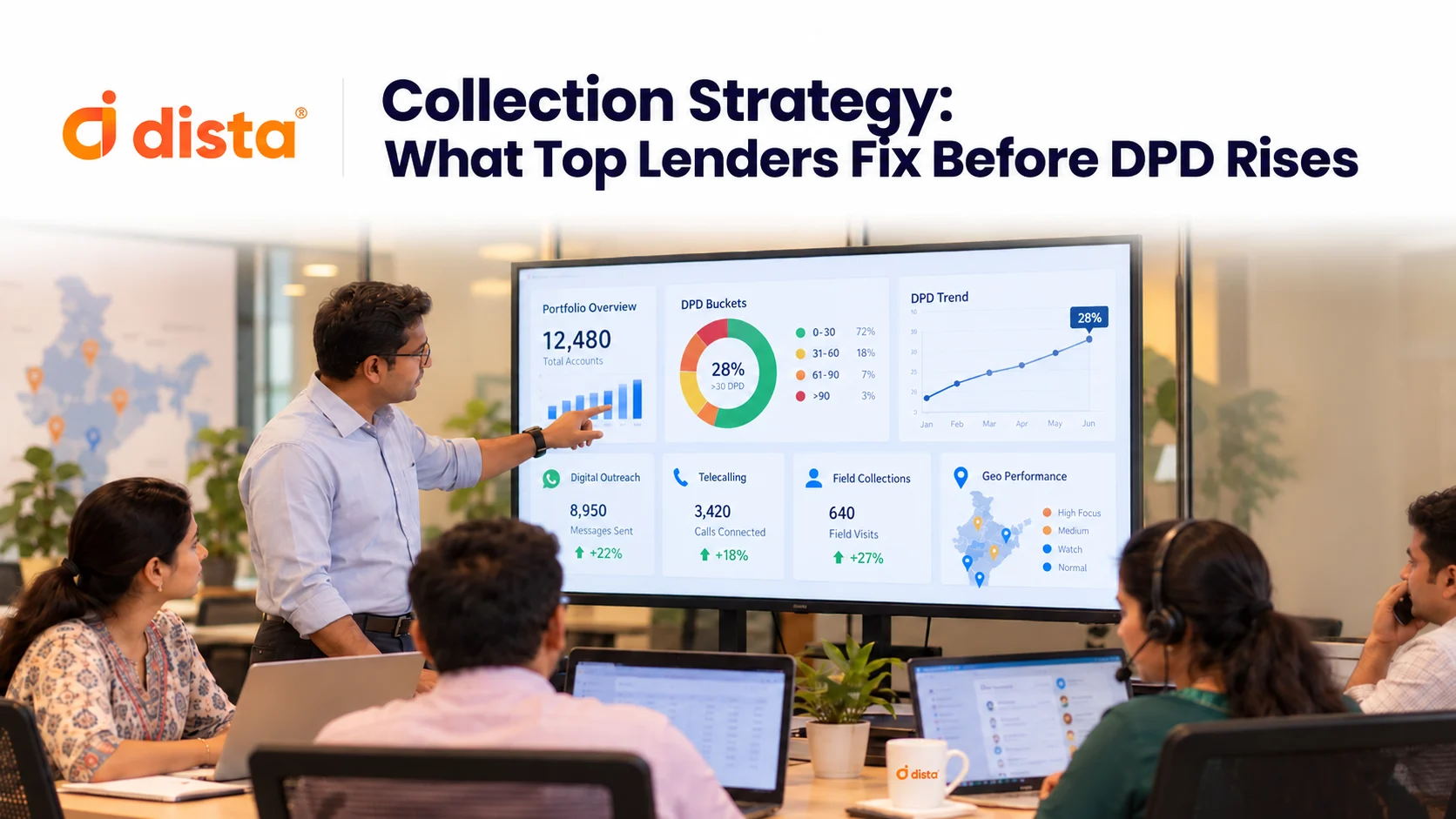
Collection strategy becomes more effective when prioritization, outreach, allocation, field orchestration and resolution are unified within the same operating flow.
Location-First Collections
Location intelligence can support much more than plotting overdue accounts on a map. It helps lenders understand where delinquency is concentrated, how field capacity is distributed and where allocation rules may need to change.
Teams can use it to:
- Identify delinquency hotspots and hyper-local clusters
- Design territories around borrower density
- Allocate cases based on proximity, skill, capacity and availability
- Build optimized beat plans and reduce unnecessary travel
Location data can also support address validation, territory simulations, resource forecasting and true-visit verification, giving collection managers a clearer view of both planning and field execution.
Omnichannel Outreach with Customer 360
Digital reminders, telecalling and field collections work better when they operate as part of the same borrower journey rather than as separate processes.

An early-stage account may begin with digital outreach or telecalling. If the case remains unresolved, it can move to field collections with the previous interaction history intact.
This is where Customer 360 becomes important. It brings together:
- Repayment and DPD history
- Promise-to-pay status
- Call and communication history
- Previous field visits and dispositions
The next team can see what has already happened without rebuilding the context from scratch. It also helps reduce duplicate communication when a payment, commitment or resolution has already been recorded.
Also read: How to Improve Recovery Rate with Unified Debt Collection CRM
Shift From Manual Rules to a GenAI-Enabled Strategy Builder
Collection strategies are often managed through spreadsheets, campaign sheets and separate operating instructions.
An AI-powered Strategy Builder brings these rules into one place so teams can define and adjust strategies by DPD, geography, borrower segment, risk, channel and contact frequency.
For example, teams can configure:
- Which accounts enter a telecalling or field queue
- How often a borrower should be contacted
- Which campaign or treatment applies to a segment
- How cases should be prioritized or allocated
GenAI-enabled intelligence can further support strategy creation and prioritization by bringing borrower, portfolio and interaction context into the decision-making process.
Field Collector Productivity
Field productivity improves when collectors have a clear plan for the day, the right context before each visit and fewer manual steps while working in the field.
This can include:
- Location-first case allocation: Assign cases using factors such as proximity, workload, skill and availability so agents are not spending unnecessary time travelling across scattered areas.
- Smart beat planning: Build a practical daily visit sequence around priority accounts, PTP commitments and working hours. Additionally, suggest the most efficient route between planned visits to reduce travel time and increase productive field time.
- Customer 360: Give agents repayment history, PTP status, previous interactions, loan details and recent dispositions before they meet the borrower.
- Pre-visit summaries: Surface the most relevant account information before a visit so agents can prepare without going through multiple screens or systems.
- In-app navigation and daily tools: Keep case information, navigation, visit updates, attendance and expense logging in one place where possible.
The aim is to make the agent’s day easier to execute: clearer priorities, less travel, better borrower context and fewer manual tasks between visits.
Real-Time Updates and Field Visibility
Collection activity changes throughout the day, so relying only on end-of-day reporting can leave a gap between planned activity and actual execution.
Real-time updates can provide visibility into case status, completed visits, field dispositions, geo-validated activity and performance across collectors, territories and agencies.
This allows managers to review what is happening while collections are in progress and act on exceptions without waiting for manual consolidation.
Built-In Settlement, Repossession and Asset Disposal Modules
Collection strategy also needs a defined path for accounts that do not resolve through regular outreach and field follow-up.
Built-in modules for settlement, repossession and asset disposal allow the case to continue within the same collection environment instead of moving into disconnected processes.
For example:
- Settlement requests can follow predefined rules and approval workflows
- Repossession cases can retain the complete account and interaction history
- Asset disposal can continue from the repossession stage without losing case continuity
Role-based access, hierarchical approvals and blanket approvals can also control who is allowed to initiate, review or approve these later-stage actions.
This keeps later-stage actions connected to the same borrower record, approvals and collection history.

Learn How Collection Leaders Are Improving Collection Throughput with AI and Location Intelligence
How Do You Know Your Collection Strategy Is Working?
Track Cure, Roll and Resolution Performance
The first question is whether the borrower was reached.
Right Party Contact and No Right Party Contact help show whether collection activity is resulting in direct borrower engagement.
Teams can then track outcomes such as:
- Promise to pay
- Broken promise to pay
- Customer unavailable
- Visit completed
- Visit not possible
- Settlement initiated
- Case escalated
These outcomes can be reviewed alongside:
- Cure rate
- Roll-forward rate
- Roll-back rate
- Collection efficiency
- Resolution rate
- True visit coverage
- True visit intensity
Breaking these measures down by DPD bucket, channel, geography, agency and collector helps show where treatment or execution may need adjustment.
Test and Improve Collection Treatments
Collection strategy needs regular review because borrower behaviour, portfolio mix and operating conditions change.
Teams can test changes to:
- Channel sequence
- Contact frequency
- Account-prioritization rules
- Collector allocation
- Territory structures
- Campaign windows
- Field visit triggers
Changes can then be reviewed against the outcome they were intended to improve before being rolled out more widely.
Build Compliance Into the Collection Strategy
Collection processes contain several rules that should not depend only on manual recall. Where possible, these can be built into the workflow itself.
Examples include:
- Role-based access controls
- Settlement rule matrices
- Approval hierarchies
- Contact timing controls
- Audit trails
- Required dispositions
- Mandatory workflow steps
- Legal-stage triggers
- Repossession controls
- Asset disposal eligibility conditions
For settlements, predefined matrices can determine which requests can proceed and which require additional approval.
Higher-value or higher-loss cases can move through hierarchical approvals, while qualifying cases can use predefined blanket approvals.
The purpose is to make the expected process visible and enforceable within the collection system.
Also Read: New RBI Guidelines for Loan Recovery: Third-Party Collections Control & Compliance
Build a Collection Strategy That Connects With Execution
A collection strategy has value when it can be applied consistently across digital outreach, telecalling, field collections and later-stage resolution.
That means bringing together the rules that decide who to contact, which channel to use, who should handle the case and what happens next — while keeping borrower history, field activity and approvals connected throughout the lifecycle.
Dista Collect brings these workflows into a location-first, GenAI-powered unified debt collection CRM, from pre-delinquency through settlement, repossession and asset disposal.
Want to see how this could work across your collection portfolio? Book a demo of Dista Collect and explore how location intelligence, GenAI and unified collection workflows can support your strategy.