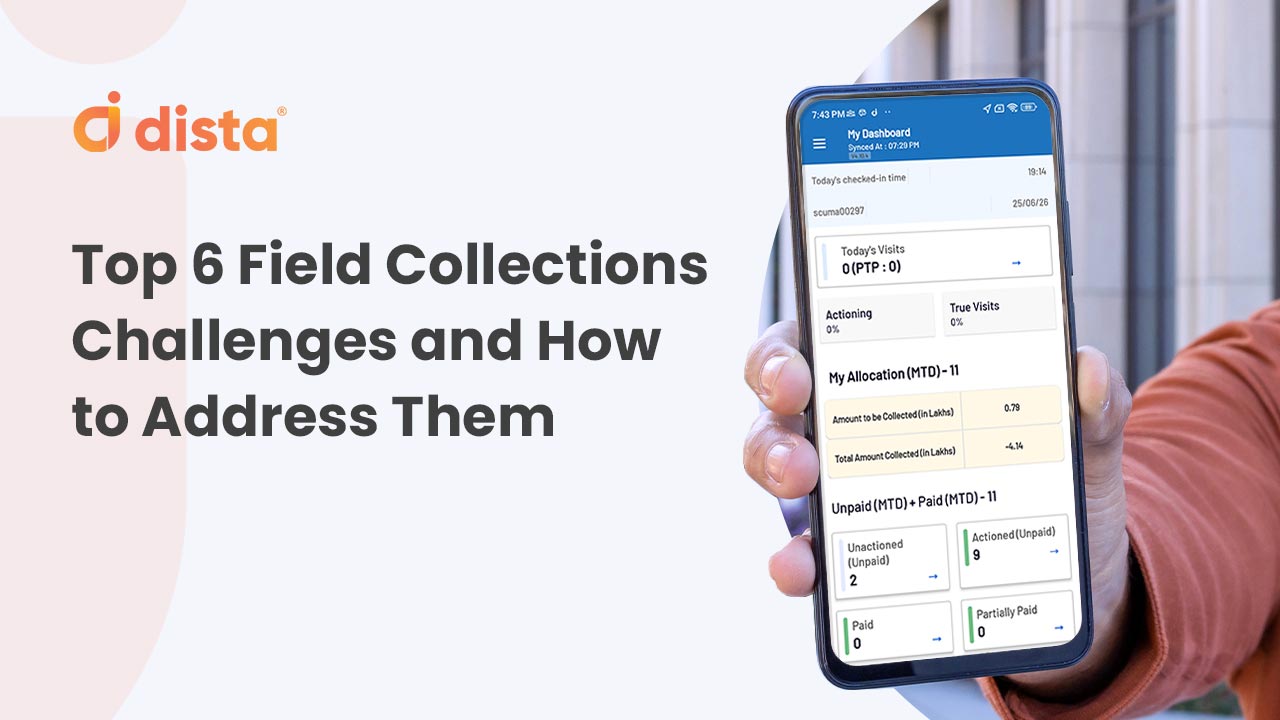
The lending lifecycle has digitised rapidly, but the last leg is where still an agent has to show up at the borrower’s door and get field collections done
What happens around that agent — how their cases are allocated, what information they carry into a visit, how their manager tracks visit outcomes, and how strategy teams measure campaign effectiveness — is still largely fragmented. This leaves collections agents overworked and under-equipped, while strategy gets decided in closed rooms with little connection to what is actually happening on the ground.
This blog lists down the core challenges in field collections and how Dista Collect, a unified debt collections CRM, helps collection agents navigate them.
Learn More: Debt Collection CRM: A Must Have to Boost Recovery Rates in 2026
What Collections Heads Are Struggling With
At the portfolio level, collections heads are dealing with three compounding pressures:
- Collections rate — the percentage of outstanding debt successfully recovered within a given period
- Cost to collect — the total expenditure across collection agents, telecalling teams, and agency networks to recover debt
- Collections coverage — the breadth of the borrower portfolio that field and telecalling teams are actively reaching
Across all three, the underlying gap is the same — collections strategy and ground-level execution operate with little visibility into each other, and the disconnect compounds with every passing day.
How Dista Collect Helps Tackle Field Collections Challenges
1. No Single Source of Truth
A typical collections team operates across disconnected systems — LMS, telecalling tools, field apps, agency portals, legal platforms, and spreadsheets. Without a unified execution layer, operations break at every handoff:
- Cases escalate to field prematurely because there is no sequencing logic between digital, telecalling, and field channels
- Telecallers re-contact borrowers that collection agents visited the day before
- Strategy decisions made at the top do not translate into coordinated ground-level execution
The list can go on and on…
Each function operates as a separate track with no shared logic governing them.
Solution
Dista Collect is the execution OS for the full collections lifecycle, with digital, telecalling, and field operations unified within one system. With business rules configured centrally, it replaces manual paperwork and spreadsheet-driven workflows with coordinated execution across every stage.

As a centralized collections CRM sitting on top of collections stack, Dista Collect acts as a single customer repository with Customer 360 insights for telecallers, field collectors, and strategy teams alike. Every customer record is updated in real time and includes:
- Interaction history
- Payment records
- Channel responses
- DPD status

Learn More: Stages of Loan Collection with Dista Collect
2. Territory Planning without Location Intelligence
According to a study, nearly 65% of organizations struggle with inadequate territory planning and design.
In NBFCs operating across tier 2 and tier 3 towns, lending often starts at the borrower’s doorstep — with an address collected at KYC. But by the time a case reaches a collections agent, that location data rarely makes it into planning.
Allocation falls back on common pincodes bucketed in spreadsheets, with
- No view of where borrowers actually are
- How much ground an agent can realistically cover
- Which specific area within that pin-code carry higher delinquency risk
Solution
Dista Collect addresses helps banks, NBFCs, and MFIs to visualize, strategize, and operationalize their collections lifecycle. Here’s how the VSO framework works:
- Visualize — map borrower distribution, delinquency concentration, and agent availability across geographies using location intelligence
- Strategize — define catchment areas, set agent deployment targets by territory, and identify coverage gaps before they become recovery gaps
- Operationalize — execute beat plans, optimize routes, and deploy collections agents based on real portfolio data rather than static branch boundaries
When this three-step framework runs as a continuous loop, location intelligence stops being a backend input and starts driving how collections operates on the ground
3. Manual Case Allocation
Once territory is defined, the next failure point is matching the right agent to the right case.
- A 90+ DPD account needs a hard collections specialist, not a soft collections agent.
- A borrower 2 kilometres away should not go to a collector based 40 kilometres out.
But without an intelligent case allocation system, these mismatches happen at scale.
Solution
Dista Collect’s allocation engine factors in all the importance factors, such as Skillset, Proximity, Availability, Capacity, and Experience — to assign the right collector to the right case.

It can run across 2.5 million records, with route optimization and demographic enrichment layered in to maximize visits per day.
4. Unverifiable Field Activity
When collection agents mark visits as complete without reaching the borrower, managers have no way to distinguish a genuine interaction from a false one. Over time, this creates a significant gap between reported coverage and actual ground-level reach.
Beyond productivity, unverified field activity creates compliance exposure as RBI guidelines require documented evidence of borrower contact attempts.
In such cases, true visits become the only verifiable proof that a face-to-face interaction has actually happened with the borrower’s consent in a formal way.
Solution
The Dista app records every field visit into a verifiable proof.
- Gen-AI powered-liveliness check of photos clicked at customers’ location
- Geocoded timestamps log every action as it happens
- Disposition tracking captures what transpired at each interaction
The result is an audit trail that holds up on both productivity and compliance.
Collections teams using Dista Collect report 25% higher true visits compared to pre-implementation baselines.
5. Low Field Productivity
Collections is an incentive-driven activity, but the agents can only perform when they are equipped with the right tools and knowledge. Not every agent knows the product well, plans their route efficiently, or follows best practices. And with attrition being a constant reality, there is always someone new who needs to get up to speed fast.
Solution
Dista Collect addresses agent productivity directly through the field app:
- One super app — everything an agent needs in a single app, from case details and customer history to route navigation, pitch guidance, and expense and attendance logging, so there is no switching between tools mid-field
- Route optimization — location-driven beat plans sequence visits to minimize travel time and maximize customer face time per day
- Smart pitch feature — collections agents carry contextual, borrower-specific guidance into every interaction, so conversations are informed rather than improvised
- Nudges and notifications — real-time prompts guide collections agents on priority cases, ad-hoc cases near their current location, follow-ups, and time-sensitive actions during the workday
- Gamification — performance targets and incentive tracking built into the super app drive daily accountability and motivation
- Leaderboards — agents can see where they rank against peers, creating healthy competition and a self-driven push to perform
Lending institutions have achieved 88% higher agent productivity with on Collect.
6. Judgment-based Settlement Decisions
RBI guidelines are explicit and stringent: settlements must be borrower-initiated. Despite this, there’s always a possibility that field collectors can use their discretion to influence settlement decisions, creating direct regulatory exposure and inconsistent outcomes across similar accounts.
Dista Collect enforces compliance and consistency through:
- Settlement authorization — field collection agents document borrowers’ intent to settle the loan
- Settlement rule matrices — pre-coded, product and bucket-specific thresholds replace collector discretion
- Approval hierarchies — requests are routed to state, zonal, or national heads based on loss amount, with blanket approvals provisioned for low-risk cases
- Automated CIBIL reporting — handled at the system level as mandated, with no manual intervention required
Achieve the 90% Collection Rate with Dista Collect
The aforementioned challenges are not unique to any one lending institution; they show up across every NBFC and MFI running field operations at scale.
Dista Collect brings every case, every stage, and every stakeholder, into one execution layer, so collections teams spend more time recovering debt.
Reach out to our location experts to see how this plays out for your collections operations.