The very nature of the NBFC model in India (delivering agile, rapid finance to SMEs and underserved segments across diverse geographies), means these institutions possess an intimate understanding of borrower behavior. This massive footprint has generated a wealth of data that most traditional financial institutions can only dream of. Consequently, the core operational hurdle is no longer generating the insight, but bridging the gap between what the system knows and what can be executed on the field.
Historically, collections in NBFCs have been treated as a cost center to manage down, rather than a core capability to build up. That framing held until rising portfolio stress forced a reckoning.
According to the RBI’s Financial Stability Report, stressed assets among NBFC-MFIs climbed from 3.9% to 5.9% in just six months ending March 2025.
Mid and large NBFCs routinely generate sophisticated repayment scores, contact propensity models, and DPD bucket data. Yet, field agents head out every morning with nothing but a static account list – no optimized route, no visible visit history, and no signal on whether borrowers require an in-person visit versus a digital nudge.
The Gap Between System and Street
Behavioral scoring and propensity models, without tight operational integration, lead to debt collections fragmenting in predictable ways:
- Batch-processed data: Delinquency metrics are updated in delayed cycles rather than real time.
- Siloed borrower context: Interaction data remains scattered across CBS, LOS, and third-party systems, leaving no single source of truth.
- Arbitrary case distribution: Allocation that relies on broad geography, completely ignoring agent capacity or performance history.
Why Field Collections Bear the Highest Damage
Field collections remain irreplaceable in India due to a widely dispersed population and pockets of low connectivity. Even for early DPD accounts, especially in rural areas and high-ticket cases, the street is the primary recovery mechanism.
Most industry benchmarks peg average field agent capacity at 50 cases per month. Without intelligent routing, a massive portion of that capacity is wasted on travel inefficiencies, duplicated visits, and manual reconciliation.
Moreover, managers don’t have a real-time view of which accounts are being touched and which are falling through the cracks.
Beyond Surveillance: The Strategic Role of Location Intelligence
This is where the technology discussion must mature to include Location intelligence, not as a surveillance mechanism, but as the operational layer connecting the Loan Management System (LMS) to real-world borrower context.
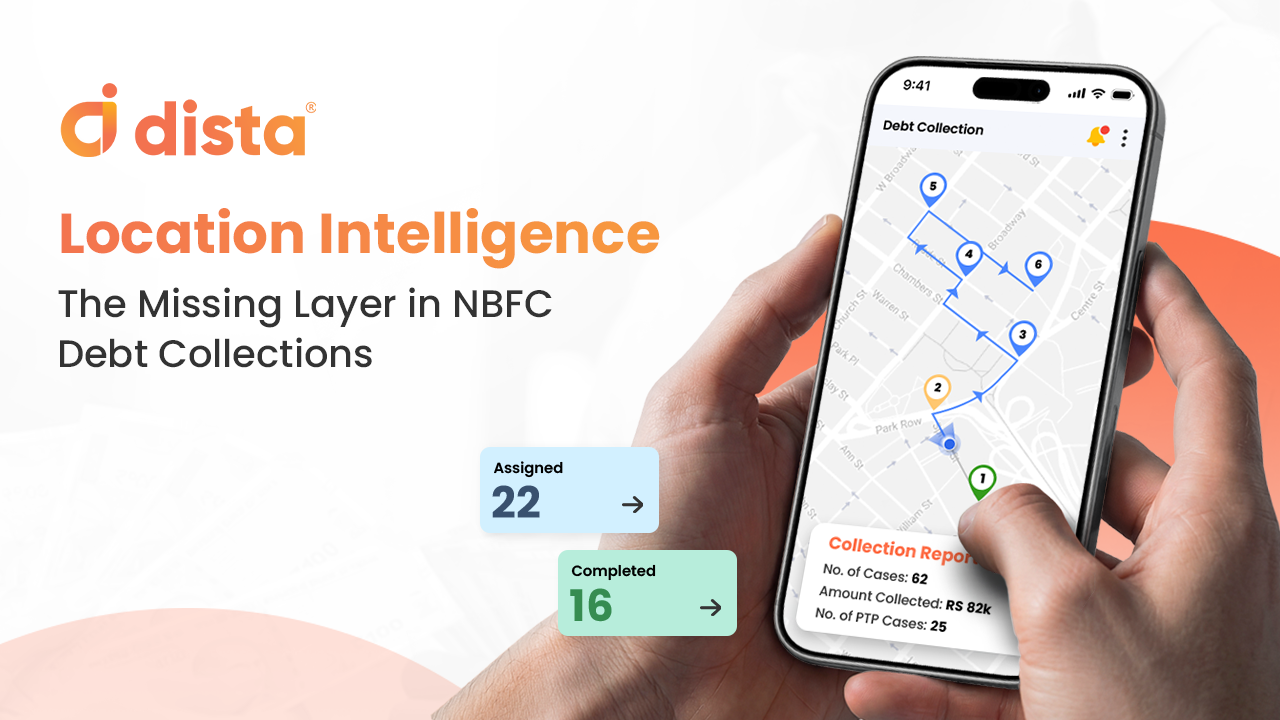
With location intelligence, beat planning evolves from a static spreadsheet into dynamic, geography-informed allocation:
- Density over distance: Accounts are clustered by proximity and weighted by DPD severity. An agent covering 12 accounts within a 6-kilometer radius fundamentally outperforms one chasing the same number of accounts spread across 18 kilometers in an arbitrary sequence. Compounded across a field force of 40 agents over a quarter, this shift directly moves recovery metrics.
- Audit-ready compliance: Geofenced attendance and visit verification eliminate self-reporting ambiguity, giving collections managers the concrete audit trail that tightening RBI compliance increasingly demands.
- Real-time agility: If a high-priority account escalates mid-day, managers can reroute the nearest available agent in minutes, rather than the next morning.
Over time, this location-anchored data trail feeds back into delinquency risk models to answer macroeconomic questions:
– Which specific geographies show lower first-visit resolution rates?
– Which beat patterns correlate with higher Promise-to-Pay (PTP) conversions?
Dista Collect: An Integrated Stack, Not Another Tool
The most capable operations are moving away from bolted-on workarounds toward a genuinely integrated model where the LMS, intelligence layer, and field execution layer operate in tandem.
This is the operational gap Dista Collect is built to close. The platform manages the full collections lifecycle, from pre-due digital reminders through to post-default resolution.
- Field agents work from a unified Customer 360° view—accessing loan history, repayment behavior, and prior interaction data at the point of visit, not back at the office.
- To maintain momentum, settlement facilitation is embedded directly into the field app via single-click payment requests, eliminating fractured workflows.
- Real-time field visibility, smart beat allocation, geofenced verification, and closed-loop LMS integration operate as a single, unified layer.
Read – A Guide to Boosting Recovery with Precision Allocation
The next evolution in debt collection intelligence isn’t a radical leap; it is the logical extension of infrastructure being built right now. Location signals will increasingly feed predictive contact models, and field outcomes will influence DPD bucket movements in near real-time rather than on weekly sync cycles.
Want to explore how your NBFC can get a headstart?