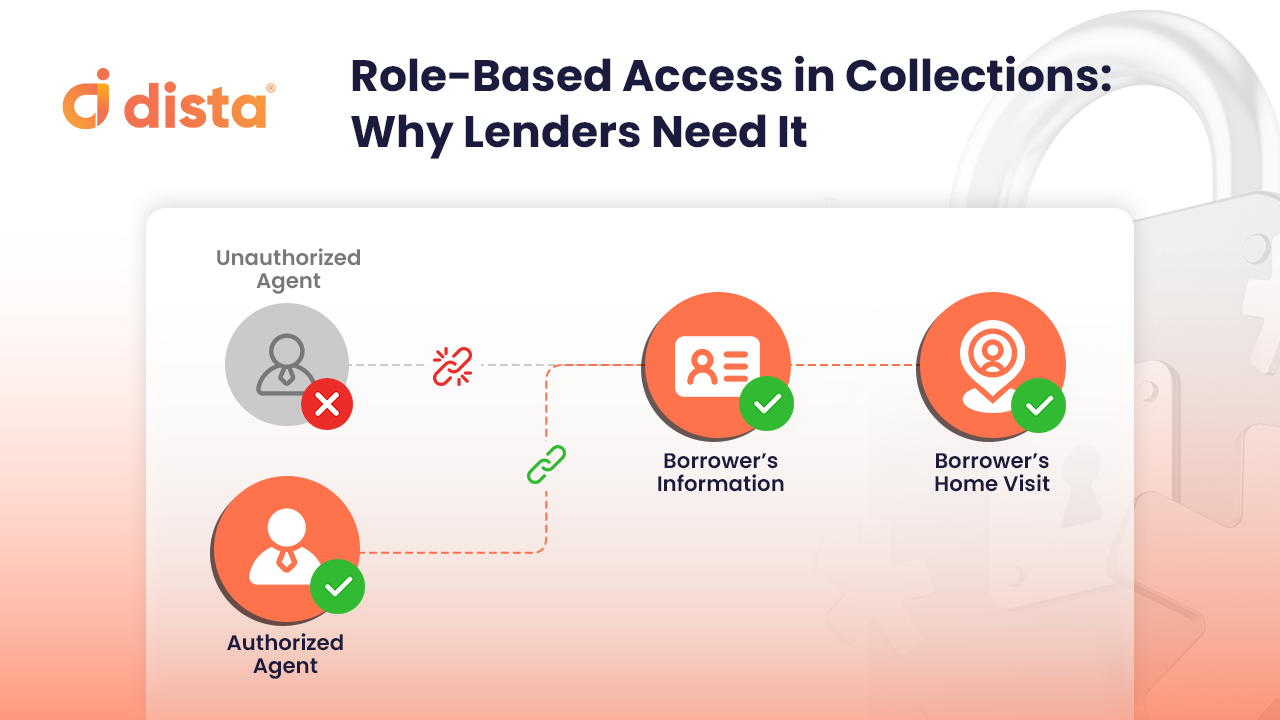
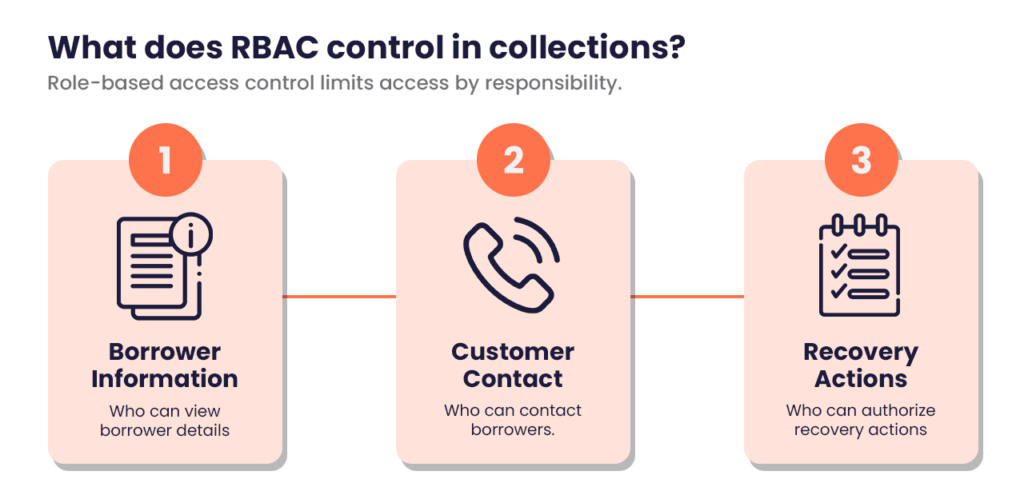
In debt collections, a borrower data leak can put an unauthorized person on someone’s doorstep. Role-based access control (RBAC) helps lenders prevent this by restricting who can view borrower information, contact customers, and authorize recovery actions.
A collection agent needs an address and an outstanding balance to complete a visit. That agent must have least privilege access to every borrower in the branch.
For banks, NBFCs, and MFIs, Data Access Control must depend on two things: the user’s role and the accounts assigned to that user.
In short:
- RBAC in collections controls data visibility, permitted actions, and approval authority.
- Role alone is not enough. Access must also follow the current account assignment.
- Receipting, approving, and reconciling a payment should sit with different people.
- Agency access must expire or change when allocations change.
What Is Role-Based Access Control in Collections?
Role-based access control (RBAC) in debt collections is a permission system that determines what each user can see and do based on assigned responsibility. It governs three things: data visibility, permitted actions, and approval authority. For lenders, this means limiting borrower records, collection activities, and financial decisions to authorized personnel.
Why Collections Needs More Than Standard RBAC
Standard RBAC follows the principle of least privilege: users receive only the access their work requires.
Collections need an additional layer, because responsibilities shift with recovery stages and agency assignments. A job title alone cannot tell a lender which borrower records a person should see.
Unauthorized Data Access Creates a Privacy Risk
In most business systems, unmanaged access creates a data leak risk. In collections, it can also lead to unauthorized borrower contact.
A collection agent’s account view may include:
- Borrower’s name and mobile number
- Residential or business address
- Outstanding loan amount
- Days Past Due (DPD)
- Previous contact and visit history
- Promise-to-pay commitments
These details let an agent identify and approach a borrower. If someone views them outside an authorized assignment, the lender loses control over who contacts that borrower.
The concern is not only who can read borrower data, but what they can do with it. An agent who collects in one territory should not automatically see accounts in another. Unrestricted access raises the risk of unauthorized contact, duplicate recovery attempts, and misuse of sensitive information.
It also weakens accountability. If an agent visits a borrower outside their assigned portfolio, the lender needs a clear record of who had access and why.
Similarly, access to a borrower’s address should not grant authority to initiate repossession or to disclose loan details to unrelated individuals.
Permissions Must Follow the Account Assignment, Not Only the Role
Consider two collection agents working for the same NBFC. Both hold the same role and perform similar activities, but their assigned accounts differ.
If access depends only on designation, both agents could view the same borrower portfolio. A better approach combines two controls:
- Role-based access: Determines which activities an agent can perform.
- Assignment-based access: Determines which borrower accounts the agent can access.
For example, Agent A may record visits and payment commitments, but only for accounts assigned to Agent A. When an account moves to Agent B, Agent A should lose access unless another valid assignment or authorization exists.
This matters most when lenders reallocate accounts based on DPD, geography, agency performance, or collector availability.
Cash Handling Calls for Separation of Duties
Collections also involve financial transactions. Depending on the lender’s collection model, an agent may receive cash, record a payment, initiate a settlement request, or submit a waiver recommendation.
These activities require different levels of authority. An agent who records a cash collection should not be able to change the amount collected or approve an adjustment.
Likewise, a collector who earns a recovery-linked incentive should not independently approve a waiver on the same account. Separating these responsibilities reduces opportunities for unauthorized adjustments and makes discrepancies easier to investigate.
A role based permissions structure distinguishes between three functions:
- Receipting: Logging collections, receipts, and customer commitments.
- Approval: Authorizing settlements, waivers, and exceptions.
- Reconciliation: Verifying recorded payments against actual receipts and financial records.
No one person should control all three stages of a transaction without independent checks.
External Agencies Are Part of the Operating Model
Banks and NBFCs frequently work with third-party recovery agencies. These agencies may handle specific geographies, delinquency buckets, loan products, or collection portfolios.
The lender remains responsible for the borrower information it shares with them. An agency should receive access only to the accounts it is authorized to handle, and its users should never see the lender’s entire portfolio.
Access must also change when an agency’s assignment or engagement ends. If accounts move from Agency A to Agency B, Agency A should immediately lose the ability to view or act on them.
Updating an allocation spreadsheet does not revoke data already shared or permissions already granted. Lenders need a way to manage agency access alongside the actual account allocation.
What a Collections Role Hierarchy Looks Like
A collections access hierarchy should reflect the responsibilities of each user. The table below illustrates one possible permission structure. Actual permissions depend on the lender’s operating model and internal approval policies.
|
Role
|
What They Can See
|
What They Can Do
|
What They Cannot Do
|
|---|---|---|---|
|
Field Agent
|
Assigned borrower accounts and visit history
|
Record visits, payments, and commitments
|
View unassigned accounts or approve waivers
|
|
Team Lead
|
Assigned team's portfolio and activity
|
Review visits, monitor agents, escalate cases
|
Approve settlements beyond delegated limits
|
|
Branch Manager
|
Branch portfolio and collection performance
|
Reallocate cases, review exceptions, authorize permitted actions
|
Access unrelated branches without authorization
|
|
Regional Head
|
Authorized regional portfolios and reports
|
Review performance, approve escalated requests
|
Bypass the applicable approval process
|
|
Agency User
|
Accounts assigned to their agency and user
|
Perform permitted recovery activities
|
Access other agencies' cases or lender-wide data
|
|
Audit Trail Software
|
Authorized records, approvals, and activity logs
|
Review activities, investigate exceptions, export permitted evidence
|
Modify collection records or approve transactions under review
|
The table sets two separate boundaries. The first controls data visibility across agents, teams, branches, regions, and agencies. The second controls action authority, including allocation changes, financial adjustments, settlement approvals, and record modifications.
A manager may need broad portfolio visibility without unrestricted authority over every financial decision. Auditors may need access to historical records without permission to change them.
How to Set Up User Access Management in Your Collections Operation
Lenders can start by mapping the roles, data requirements, and decisions involved in daily collections. These six steps form a practical implementation checklist.
1. Map Every Collections Role
Identify every category of user who accesses collection information. Include collection agents, telecallers, supervisors, branch managers, regional heads, agency personnel, settlement teams, finance teams, and compliance auditors.
Document what each role needs to perform its assigned work.
2. Define Data Scope for Each Role
Specify which records and fields each role can view. Cover borrower contact details, loan balances, transaction records, visit history, and settlement information.
Separate portfolio-wide reporting access from account-level borrower access.
3. Tie Access to Account Allocation
Connect borrower visibility to current assignments. When an account moves between agents, teams, branches, or agencies, update the corresponding permissions.
Then test it: confirm that the previous assignee loses access to the account.
4. Separate Receipting, Approval, and Reconciliation
Define who may record payments, request settlements, approve waivers, and reconcile transactions. Set approval limits that match the lender’s authorized hierarchy.
Require independent review wherever financial duties could conflict.
5. Set Access Revocation Rules
Define when access must end. Common triggers include employee exits, agency contract termination, temporary assignment expiry, role changes, and portfolio reallocations.
Include mobile devices, exported files, and active sessions in the revocation process.
6. Review Access and Activity Logs on a Schedule
Assign a named owner to review permissions and activity logs. Look for access outside assigned portfolios, unusual exports, repeated approval overrides, and activity by inactive users.
Review privileged access and agency accounts separately. Investigate every exception and document the corrective action.
What to Look for in Collections Software
Evaluate role-based access as part of the complete collections workflow, not as an isolated security setting. When reviewing debt collection software, check for these capabilities:
- Assignment-scoped borrower access: Can a collection agent access only the accounts assigned to them? What happens to visibility when an account is reallocated?
- Agency-level access controls: Can external agencies access only their allocated portfolios? Can the lender set expiry rules and revoke permissions without relying on the agency to act?
- Action-level permissions: Can the system distinguish between recording a payment, initiating a settlement, approving a waiver, and reconciling a transaction?
- Hierarchical approval workflows: Can settlement and waiver requests follow configurable approval limits? Does the system link each approval to the relevant borrower record?
- Audit logs: Does the system record account activities, allocation changes, approvals, and user actions? Can authorized teams retrieve these records during an investigation?
- Authentication and session controls: Does the platform support secure login, device restrictions, and centralized identity management?
How Dista Collect Supports Controlled Collection Operations
Dista Collect is a location-first, unified debt collection CRM for banks, NBFCs, and MFIs. It brings digital, telecalling, field collections, and later-stage recovery workflows into one platform.
Its capabilities include:
- Role-Based Access: Controls system access based on assigned user roles and permissions.
- Authentication and Authorization: Supports single sign-on (SSO) and device-level login tokens.
- Dynamic Case Allocation: Assigns collection cases to collection agents using location and operational criteria.
- Settlement Approval Workflows: Connects settlement requests and approvals to the collection process.
- Audit Trails: Maintains records of collection interactions and field activities for review.
- Centralized Agency Operations: Provides visibility into agency activity and collection performance.
- Phone Number Masking: Helps limit direct exposure of borrower contact information.
Together, these capabilities help lenders manage access, assignments, actions, and approvals within one connected collections operation. The goal is simple: collectors and agencies can do authorized collection work without receiving unnecessary borrower information or financial authority.
See Dista Collect in action
Explore how Dista Collect connects role-based controls, case allocation, field collections, and approval workflows.
Explore Dista Collect →
Frequently Asked Questions
Role-based access control in debt collections restricts access to borrower records and collection activities based on a user's assigned responsibilities. It defines which information users can view, which actions they can perform, and which decisions they can approve. Lenders can add account assignments to restrict access further.
Field collection agents handle sensitive information, including borrower addresses, phone numbers, outstanding amounts, and repayment history. Anyone holding this information can contact borrowers directly. Restricted access ensures agents work only on authorized accounts and cannot view unrelated portfolios, change financial records, or approve transactions beyond their responsibilities.
Lenders should give agencies access only to the accounts and information their assigned recovery work requires. Each authorized user should have an identifiable login. Lenders should review permissions when allocations change, revoke them when assignments or engagements end, and keep activity records of agency data handling.
When an account is reallocated, the previous collector's access should end unless another valid authorization applies. The new collector receives the permissions the assignment requires. The system should preserve the account's interaction history and log the allocation change, so managers can trace responsibility across handoffs.
RBI does not name role-based access control, but it sets duties that RBAC helps meet. Its 2025 outsourcing directions keep regulated entities responsible for customer data confidentiality, and its recovery-agent directions, effective January 1, 2027, require lenders to limit shared borrower information to what recovery duties need.
Role-based access determines what a user may do based on job responsibilities. Assignment-based access determines which specific accounts that user may open. Two collection agents can hold identical permissions but see different borrower portfolios. Combining both controls limits the activities users perform and the records they can reach.