I was walking through the expo halls at the Global Fintech Fest 2026 and Credit and Collections Summit 2026 – both in Mumbai and I couldn’t turn a corner without hearing a similar pitch: “AI-powered voicebots, hyper-personalized dialers, and automated digital channels are ready to take over collections”.
Session after session, tech providers showcased slick demos promising to slash field costs by eliminating manual chasing and automating recovery workflows end-to-end.
Between sessions, I spoke with leaders from several lending institutions to get their unfiltered take. I thought they felt that everyone was claiming, “Digital-only collections will improve ROI” and wondered how ‘digital-only’ collections would work in microfinance, which is a behavioral, trust-based and community-enforced ecosystem.

Their questions were simple and sharp.
Can you really replace the Relationship Officer (RO) with an automated dialer?
Would it truly mean modernizing collections or will it break the very fabric of social collateral that keeps the portfolio alive?
Can it read joint liability group dynamics by looking into the borrower’s eyes to gauge sincerity, and can it leverage the collective accountability of the five neighbors who have known each other for decades?
Here are a few points worth pondering.
1. An AI Bot Cannot Read the Room
A traditional bank can freeze your account, reduce your credit score, and send a legal notice. Microfinance doesn’t have that luxury – repayment is driven entirely by reputation and peer trust.
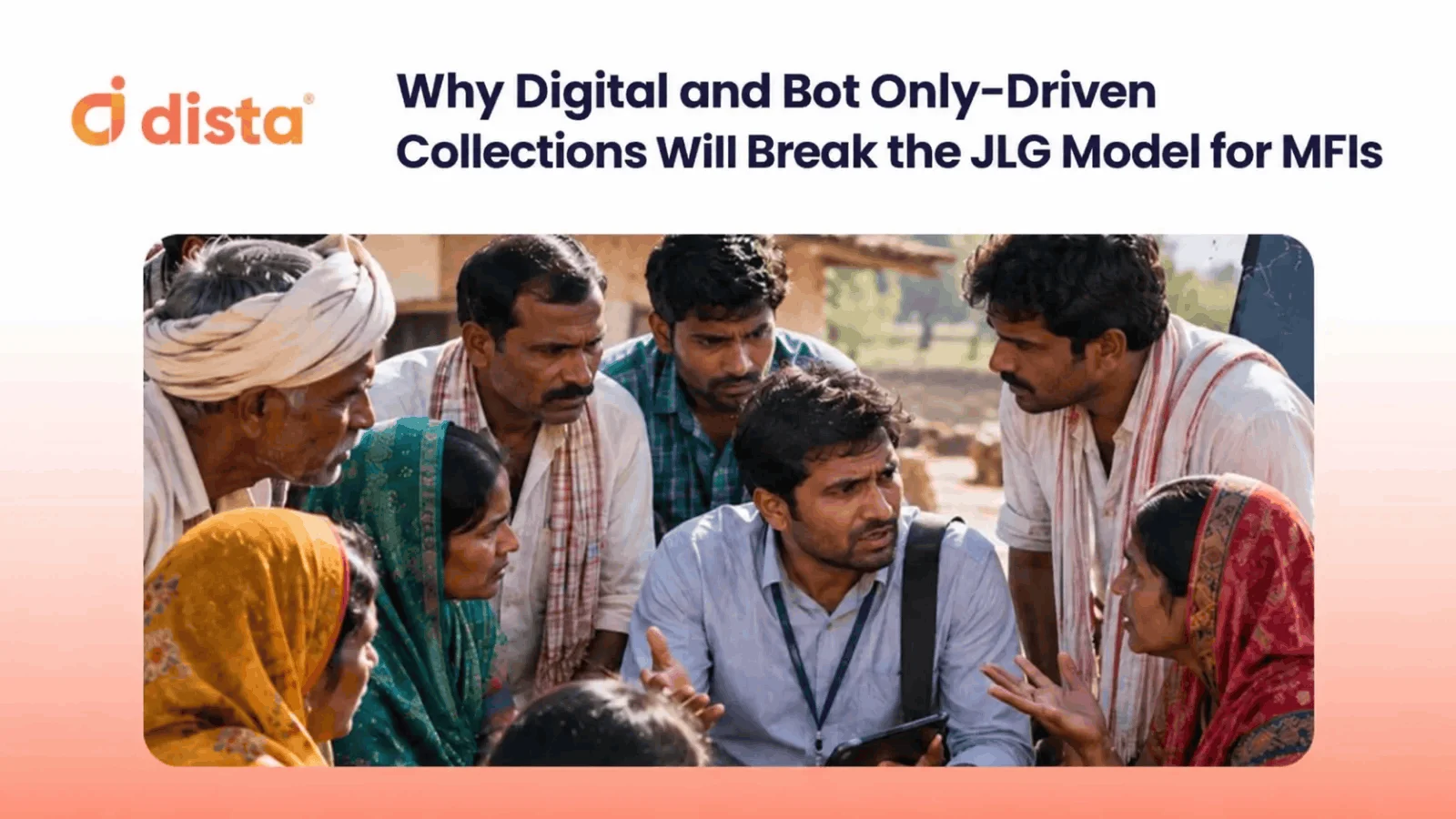
In a standard JLG model, the group is the guarantee for the individual. When a borrower is unable to make a payment on the day of collection, the joint liability group steps in to assess the member’s situation and covers the missing installment from an emergency pool or personal savings.
I’m struggling to imagine how an AI voice bot would handle a tense negotiation between a group of neighbors sitting in a village courtyard? How will an algorithm read the group and tell genuine distress from deliberate avoidance? How will it convince four other women to open their own pockets to cover a shortfall?
2. Economy Still Runs on Paper
Digital payments are expanding rapidly, but it is too early to say that 100% of transactions are digital. For the millions of daily wage earners and small vendors who make up Microfinance portfolios, liquidity means folded notes in a pocket. As long as cash dictates their daily life, collections will not happen purely through a digital screen.
When an automated SMS or voice bot sends a payment link, it assumes that:
- The borrower has a bank account and enough balance.
- The local data network is stable.
- The borrower is versed with executing digital transactions independently.
When repayment happens in cash, it will take a human to verify the rupee notes and ensure accurate counting and thereafter translate informal paper wealth into formal digital books.
3. A Phone Number Is Not a Person
I felt that almost every presentation at the Credit and Collection Summit took it for granted that when an auto-dialer rings, the woman who actually took the loan is the one picking up the call. I would say that below are the high possibilities of what actually happens on the ground in a rural setting –
- Borrowers frequently switch SIM cards to get data discounts, which breaks the digital trail overnight.
- The possibility of the registered mobile number being with the borrower attending the center meeting is low, as the family’s single handset may travel with whoever works outside the village during the day.
- Network blackspots in the rural areas
A missed phone call will tell you nothing most of the time. A field officer riding a motorcycle into a village can walk directly to the household to verify if the family is home and thus speak to the borrower face-to-face.
4. A Bot Cannot Tell if the Buffalo Is Sick
When a micro-borrower misses an EMI, the simple fundamental question every lender must answer is: Is this an inability to pay, or an unwillingness to pay?
- Temporary Inability: A medical emergency, a delayed crop harvest, or inventory stuck in transit.
- Willful Default: Siphoning funds, over-leveraging across multiple unrecorded informal lenders, or outright fraud.
How will a conversational voicebot check livestock health or find out that a small provision store has run out of stock? Distinguishing between a borrower hit by genuine catastrophe and someone simply testing the lender’s ability to recover requires feet on the ground. An RO sitting with the Joint Liability Group Leader can read the room, understand the real reason behind the shortfall, and offer genuine breathing room without letting repayment discipline slide.
5. Out of Sight, Out of Contract
Imagine in a village, an MFI scales back its RO footprint, skips routine center meetings, and tries running digital debt collections through a call center. The local grapevine will reach an immediate conclusion: the company is packing up and leaving. In Microfinance, that perception will be catastrophic. The moment borrowers realize no one is riding a motorcycle down their lane to check on an overdue account, discipline will break. One default will become three, three will become an entire center. Within a few cycles, you will be dealing with a full-blown default pandemic.
A field officer’s physical presence should not be only looked at as an operational expense – instead, it should be looked at as the anchor that keeps the portfolio honest.

Don’t Fire the Field Officers - Arm Them
This certainly does not mean technology has no place in helping Microfinance to move towards digital debt collection. The fatal mistake is viewing AI and digital channels as replacements for field agents rather than a support structure that can amplify their efficiency.
Pitching digital-only collections in microfinance is like an army claiming it can disband the infantry because it bought drones. Drones can spot movements and strike from a distance but you cannot secure ground without boots on the dirt. The real breakthrough in modern warfare was never eliminating the soldier – it was outfitting the soldier with night vision, encrypted communication devices and live aerial feeds. Likewise, in collections, AI voicebots and digital payment links shouldn’t fight the ground war alone. Their entire job is to provide tactical air cover, feeding real-time context to field officers.
Which will ensure that the field officers can dedicate 100% of their physical field hours to what humans do best: building trust, assessing ground-level credit risk, mentoring borrowers, and preserving portfolio quality where technology reaches its limit.