A sales cycle is the sequence of activities that takes a prospective customer from lead identification to a recorded sales outcome. For Indian banks, NBFCs, and MFIs, the sales cycle often spans branch inquiries, digital leads, channel partners, field visits, and application processing. An opportunity may refer to a loan, MSME working capital, a savings account, or any other financial product.
Each of these have different checks, customer interactions, and decision points. A well-defined sales process helps sales heads monitor lead ownership, conversion, pending documents, and follow-up across branches and territories. It also separates the work of sourcing and converting customers from credit decisions, account opening, and disbursal milestones that may require additional review.
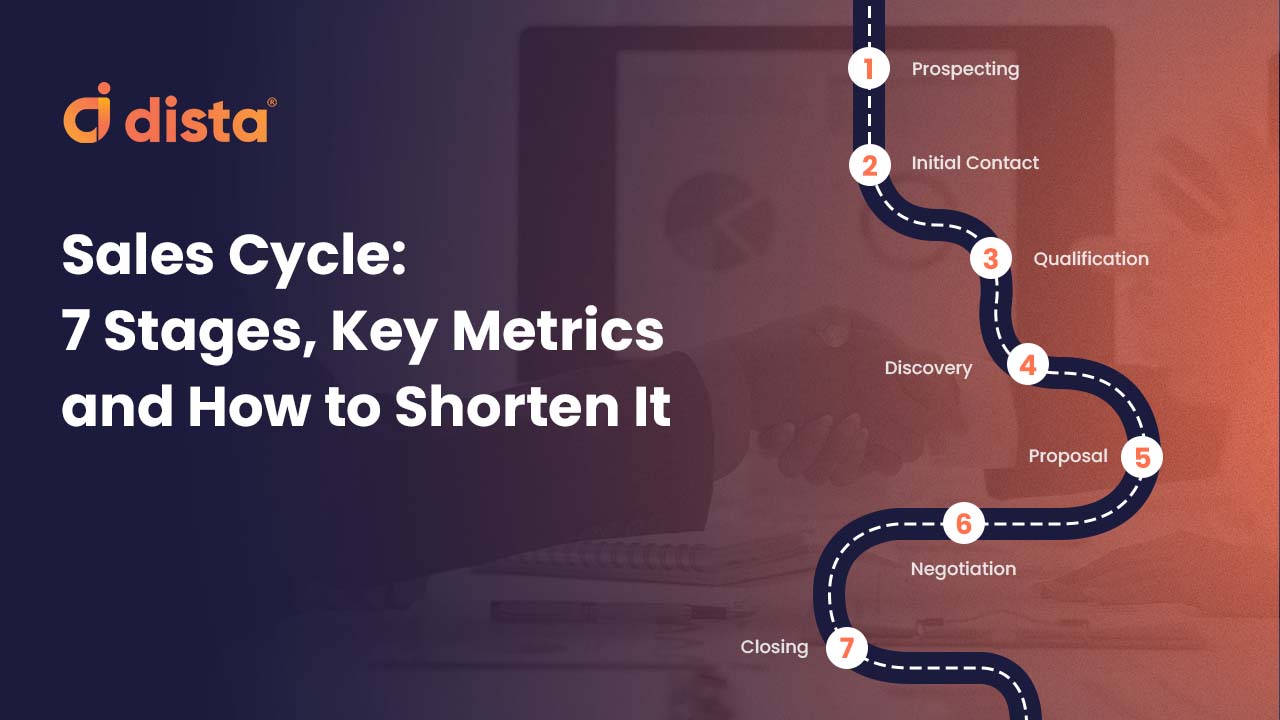
The seven-stage Sales cycle framework describes the stages that a sales opportunity goes through as it moves from being a potential lead to a recorded decision. Banks, NBFCs, and MFIs may rename or combine stages to suit retail lending, MSME acquisition, deposits, or field-led distribution.
This guide walks through the seven stages of the sales cycle for BFSI sales teams in India, explains what makes a cycle longer and shows how technology supports sales cycle management.
What Are the 7 Stages of the Sales Cycle?
The seven-stage framework below describes how a deal moves from identifying a fit customer to closing the sale. Organizations often rename or combine stages to match their own process and products. A team selling retail loan products may merge qualification and discovery, while a team selling to corporate or MSME clients may split proposal and negotiation into separate gates.

What matters is that each stage has a clear purpose and a defined exit point. Reps and managers should agree on what must be true before a deal moves forward.
1. Prospecting
Prospecting identifies the accounts or individuals that fit your ideal customer profile (ICP). The goal is a focused target list, not a large one.
Reps and relationship managers build this list from branch walk-ins, referrals, existing customers, direct selling agents, inbound inquiries and local market research. A written ICP keeps the effort directed more closely at customers who meet the product’s eligibility criteria.
It also gives marketing and sales a shared definition of a good fit.
The common pitfall is favoring volume over fit. A long list of weak leads fills the pipeline, slows every later stage and distorts forecasts.
2. Initial Contact
Initial contact is the first real exchange between your sales team and a prospect. It covers the outreach message, the speed of your response to inbound inquiries and the channel you choose, whether phone, email, WhatsApp or an in-person visit.
Match the channel to the buyer
A field visit may suit a shop owner applying for a business loan in a regional town, while a call or email may suit a finance head at a corporate client. Respond to inbound inquiries quickly, because delay gives a prospect time to engage a competitor.
A common pitfall is inconsistent follow-ups, which lets interest cool before a conversation starts.
Speed at this stage has measurable effects. Dista Sales customers have cut lead response time from 14 days to under 2 hours, a 99% improvement, and have recorded a 27% lift in sales conversion and 150% faster M0 conversions.
3. Qualification
Qualification tests whether a prospect deserves further effort-intensive investment. Reps assess fit, need, authority, budget, urgency and potential value, often using frameworks such as BANT or MEDDIC.
Strong qualification relies on direct questions about the problem, the decision-maker, the budget and the timeline. In lending, qualification also covers early eligibility checks, such as income, existing obligations, document readiness and KYC status, so applications that cannot clear credit review leave the pipeline early.
The common pitfall is weak qualification criteria. Unqualified deals stay in the pipeline, consume rep time and pull attention from deals that can close.
4. Discovery
Discovery maps the buyer’s pain points, desired outcomes, stakeholders and buying process. The goal is to understand the problem well enough to propose a solution that fits it.
Sales agents often ask questions, listen for the cost of the current approach and identify who else will weigh in on the decision. They also learn how the buyer purchases, including approval steps, review requirements and timing.
The common pitfall is pitching too early. Presenting features before understanding the problem produces a proposal that misses the buyer’s priorities and invites rework, and in worst cases lead leakage or loss.
5. Proposal
The proposal connects your offer to the requirements the buyer stated during discovery. It covers the product, pricing, scope and the value the buyer can expect. For lending, that includes the interest rate, processing fees, tenure and repayment schedule, stated clearly and consistent with the RBI Fair Practices Code.
Strong proposals use the buyer’s own language, address each stakeholder’s concern and spell out what happens after signature. Reps often pair the document with a repayment illustration or a working session so the buyer can test the offer against their own cash flow.
The common pitfall is a generic proposal. A document that ignores discovery findings forces the buyer to translate your offer into their context, and that effort slows the decision.
6. Negotiation and Objection Handling
Negotiation resolves the objections and commercial terms that stand between a proposal and a signature. Buyers may raise concerns about rates, fees, tenure, collateral, timing or competing offers. Procurement, legal and approval teams may add requirements on the buyer side, and credit or compliance teams may add conditions on the lender side.
Reps respond by restating value for the customer, clarifying scope and trading concessions for commitments. Involving the right internal approvers early, such as a sales leader or a legal reviewer, keeps the process moving.
The common pitfall is conceding on rates or fees by reflex. A concession offered without a clear exchange weakens the deal and may not address the underlying objection.
7. Closing
Closing covers the final agreement, documentation, disbursal or premium payment, and the handoff to the team that will onboard and service the customer. Reps also record the outcome as closed-won or closed-lost.
A clean close includes a clear documentation process, a confirmed disbursal or start date and a documented handoff, so the servicing and collections teams understand what the customer agreed to. Closed-lost deals deserve a short review of the reason, because patterns in losses show where earlier stages need work.
The common pitfall is a weak handoff. A customer who must repeat their details to a new team can lose confidence at the start of the relationship.
What Makes a Sales Cycle Longer?
- Poor lead qualification
Deals that never fit the ICP consume rep time and stall in the pipeline. - Slow first response or inconsistent follow-up
Gaps between touchpoints let buyer interest cool and push decisions out. - Unclear next steps or missing stage exit criteria
When reps and buyers do not agree on what happens next, deals sit in one stage without progress. - Multiple decision-makers and buyer-side approvals
Each additional approver adds a conversation, a possible delay and a new set of concerns. - Legal, procurement, compliance or security reviews
Banks, NBFCs and other regulated buyers may require formal reviews before they sign, and lenders run their own credit, KYC and compliance checks on applicants. - Field-sales travel, territory or scheduling delays
In-person meetings depend on distance, route planning and rep availability, which matters more where customers live far from the nearest branch. - Incomplete activity or CRM data that hides stalled opportunities When reps log activity inconsistently, managers cannot see which deals have stopped moving.
Many of these causes overlap. A deal with weak qualification, for example, may also lack clear next steps and a mapped buying committee. Fixing one factor often exposes the next, so teams benefit from reviewing the full list rather than a single cause.
Start with the factors your own pipeline data confirms. If deals stall at approval, focus on stakeholder mapping and early reviews. If they stall before a proposal, focus on qualification and response time.
How Technology Supports Sales Cycle Management
Technology gives sales teams shared visibility into every deal. A CRM stores contact history and stage data in one place, so managers can see where each opportunity stands. In lending, the CRM works alongside the loan origination system (LOS), which handles applications and credit decisions.
Workflow automation handles lead allocation, reminders and next-action prompts, which keeps follow-up consistent across reps.
Analytics show where deals stall, and location intelligence helps field teams plan visits by branch catchment, pin code and proximity. Together, these tools support activity visibility, stage tracking and clean handoffs between sales, credit, operations and servicing teams.
Frequently Asked Questions
What is the sales cycle?
The sales cycle describes the activities used to turn a prospective customer into a recorded sales outcome. In Indian banking and financial services, it can include lead sourcing, contact, eligibility discussions, product selection, application documentation, and follow-up.
Its closing milestone depends on the product and institution. Loan applications, credit sanction, and disbursal are distinct events, so teams should specify which one they measure.
What are the 7 stages of the sales cycle?
The stages are prospecting, initial contact, qualification, discovery or needs assessment, proposal or solution presentation, negotiation and objection handling, and closing. A bank or NBFC may use different names or separate application and approval milestones.
What matters is that sales representatives understand the entry criteria, required customer information, next action, and owner at each stage. This makes opportunity movement easier to review.
What is the B2B sales cycle?
The B2B sales cycle covers the process of selling products or services to another business. For an Indian bank, that could involve current accounts, merchant services, or financing for an MSME.
A proprietor, finance manager, authorized signatory, and internal review team may influence the decision. The salesperson needs to record business requirements and buying authority while keeping commercial discussions separate from formal credit or compliance approvals.
What is the 3-3-3 rule in sales?
The 3-3-3 rule is an informal sales heuristic, and there is no single definition that applies across organizations. Teams may use the phrase for their own planning, outreach, or follow-up routines.
Before using it, confirm which activities your sales team means and how they should be measured. In financial services, any routine must also respect customer preferences and the institution’s approved contact practices.
How do you calculate sales cycle length?
Calculate sales cycle length as total days to close across won deals ÷ number of won deals. Use a consistent start date and a clearly defined closed-won milestone for each opportunity.
Measure results by product and customer segment, since a savings account, an MSME loan, and a merchant acquisition may follow different processes. Review time spent in each stage to locate delays that an overall figure cannot explain.
How can you shorten the sales cycle?
Start with delayed lead assignment, repeated customer contact, missing information, and unclear ownership between sales and processing teams. Qualify inquiries early, prepare document requirements before visits, record next actions, and keep application status visible to the responsible teams.
Compare stage-level delays and lost-opportunity reasons by product. The goal is to reduce avoidable waiting while retaining required credit, compliance, and customer-consent checks.
If your bank, NBFC, or MFI is reviewing lead allocation, field visits, and handoffs between sales and processing teams, get a Dista Sales demo. Discuss the workflow, ownership rules, and activity information your teams need to manage each opportunity.