Key Takeaways
|
According to a survey by Boston Consulting Group (BCG), 95% of executives surveyed indicated that mapping and geospatial data are crucial for achieving business results.
Building on this proliferation, industries such as BFSI, CPG, and logistics are increasingly relying on location intelligence to drive key business use cases.
Moreover, the rise of IoT and connected devices has accelerated the convergence of spatial data and location intelligence, transforming how businesses perceive, interpret, and utilize geographic information.
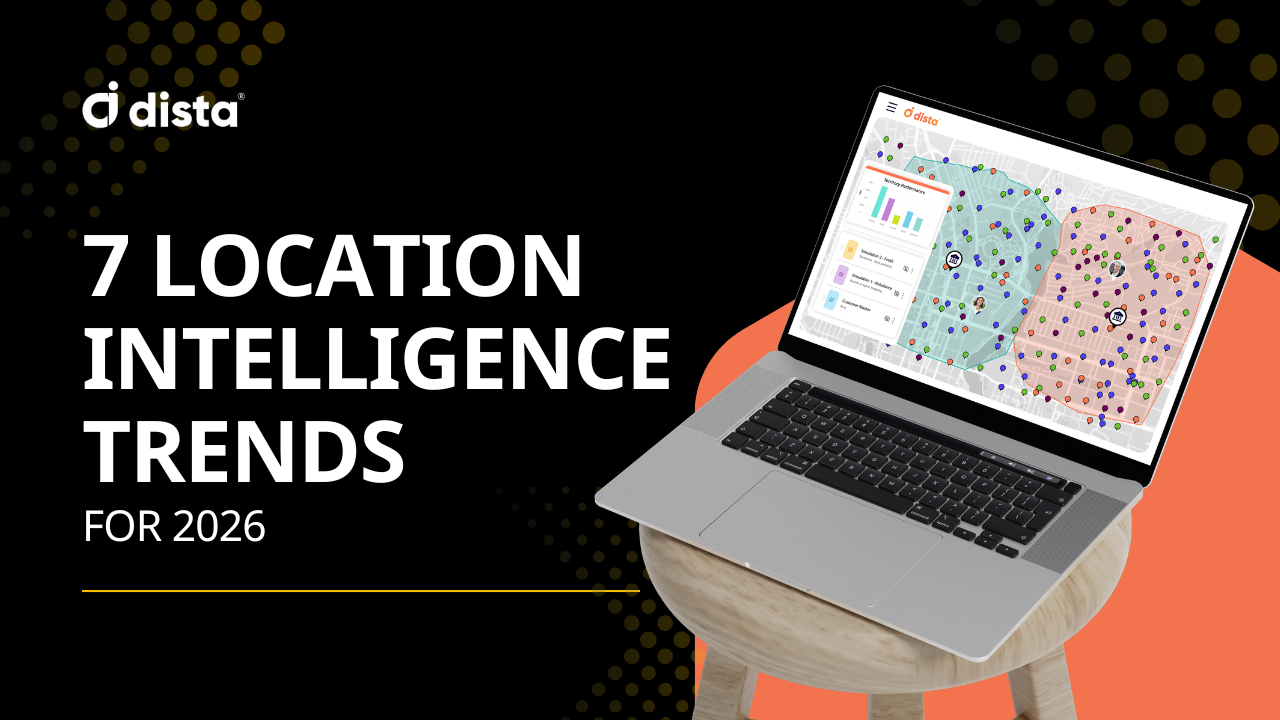
This article explores the top seven location intelligence trends for 2026, set to unlock new applications and strategic opportunities for enterprises
Also Read: Key Location Intelligence Concepts and Terminologies
1. Data Availability and Real-time Analysis
The expansion of 5G connectivity and increased bandwidth has enhanced the ability of enterprises to capture and process real-time location data and derive actionable location insights from platforms like social media and mobile GPS. These are used for,
- Personalization: Insights derived from the data enable businesses to offer personalized experiences by analyzing demographics, composition, and other key data components.
- Contextual Intelligence: Social media posts also carry a critical location component that provides deeper contextual, real-time insights for addressing several use cases.
- Operational Efficiency: By leveraging these insights, organizations can visualize their operations, strategize new plans, and enhance efficiency to become more productive and profitable.
2. Integration of AI/ML Algorithms
Deep integration of GenAI and ML algorithms has enabled faster processing of vast geospatial datasets, uncovering patterns and trends that traditional methods often miss.
AI-powered analytics and ML algorithms help create hyper-personalized customer experiences by merging location data with behavioral insights. They can also predict customer behavior, market demand, and resource allocation with precision.
Key applications in the BFSI sector include
- AI-driven models that analyze geospatial data to identify leads, increase customer facing time, optimize field operations, and design dynamic beat sales routes.
- ML-powered analytics that enhance branch and ATM location strategies while improving risk assessment by detecting location-based fraud patterns.
The integration of AI, ML, and location intelligence transforms geospatial analytics from being static to being dynamic, predictive, and actionable, thereby unlocking greater efficiency, accuracy, and profitability.
3. Improve Last-Mile Delivery
Location intelligence helps improve delivery efficiency and accuracy to manage costs better and create a more sustainable delivery process. It helps optimize delivery routes and schedules while reducing overall travel distance.
Industries that fulfill last-mile and instant deliveries also require verified addresses to reduce the rate of unsuccessful deliveries. A smart address verification system like geocoding removes inconsistencies and eliminates manual redundancies to provide accurate location information.
Companies have recorded a remarkable increase in First Attempt Delivery Rate (FADR) by leveraging location intelligence platforms to,
- Optimize delivery routes using real-time traffic insights for faster and more efficient dispatch
- Enable active location tracking for monitoring delivery agent movement
- Analyze order data for generating accurate and dynamic ETAs
- Provide customers with live order status updates, enhancing transparency and overall experience
4. Fleet Management for EVs
Rising pollution levels and their cumulative environmental impact have prompted organizations to consciously shift towards employing the use of electric vehicles (EVs) for deliveries.
However, the shift can be tricky due to the limited driving range of EVs and fewer charging stations, thereby impacting planned deliveries.
Location intelligence simplifies EV fleet management by
- Mapping charging stations and optimizing delivery routes
- Tracking and analyzing EV movement patterns on high-traffic corridors with aggregated route data
- Identifying demand hotspots and determining optimal locations for new charging stations
Similarly, organizations that manufacture and sell battery packs for EVs can utilize location intelligence for
- Tracking deliveries and dispatch
- Demand Analysis
- Placing new stations for riders to swap out old packs with newly charged ones
Read More: Australian On-Demand Grocery Delivery Service Orchestrates Delivery With Dista
5. Enhanced Customer Experience
According to a report by BCG , 63% of leaders in the financial sector reported using Geomarketing, i.e., employing spatial data to send marketing nudges, as a key component of their marketing strategy. Rich customer experience and tailored brand messaging are essential for businesses to enhance and expand their existing consumer base.
Restaurants are using location intelligence to design targeted local marketing campaigns and deliver timely product or service offers.
In the BFSI sector, banks and financial institutions can use location data for
- Delivering personalized banking services, such as location-based credit card, loan, or insurance offers
- Identifying high-potential micro-markets for branch expansion or ATM placement
- Strengthening fraud detection by flagging unusual transaction patterns based on geographic behavior
Ultimately, the main aim is to increase footfall and improve customer engagement.
Also Read: How a Pizza Chain Giant Strengthens Market Expansion Strategies with Dista Insight
6. Indoor Mapping
Location intelligence is vital to indoor mapping, providing precise spatial insights and enabling real-time navigation.
Indoor mapping enhances user experiences, optimizes operations, and improves resource management by integrating with key data components from AI and IoT.
From guiding customers in retail stores and travelers in airports to optimizing workflows in warehouses and healthcare facilities, location intelligence ensures
- Efficient movement
- Asset tracking
- Adequate Space utilization
Together, these capabilities empower industries to build smarter, more efficient, and accessible indoor environments.
7. Privacy-first Location Intelligence
As stricter regulations like GDPR, CCPA, and India’s PDP Act are enforced, enterprises are expected to prioritize privacy-first practices in location intelligence. This calls for a structured approach to
- Adopting secure and anonymized data collection frameworks to safeguard customer information
- Processing location data using advanced encryption techniques and compliance-ready tools aligned with global and regional regulations
- Embedding privacy-by-design principles into location intelligence systems to reduce regulatory risk and strengthen data governance
Enterprises that demonstrate their commitment to privacy, such as offering consent-based data usage options or detailed privacy policies, are likely to gain a competitive edge by positioning themselves as trusted partners in a privacy-conscious era.
Also Read: A Definite Guide to Transform your Field Operations with Location Intelligence
Unlock the Full Potential of Location Intelligence in 2026
As enterprises across adapt to rapid technological shifts, location intelligence is becoming a practical driver of smarter decisions and sustained growth.
The real competitive advantage will go to businesses that don’t just collect spatial data, but actually use it — to improve operations, spot opportunities, and respond to customers with greater precision.
If you’re looking to move toward a more predictive and performance-driven operating model, get in touch with our location experts.